Hasbro (HAS) Short
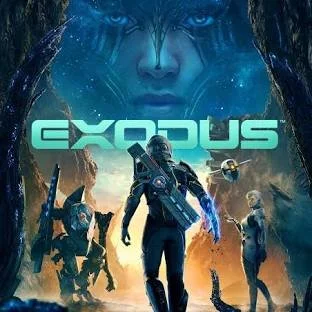
Just found out I could add images and not just blocks of text.
I’ve had some free time to do some research this summer, in between working for my internship, and I thought I would look for a short. I have always been very long-biased because I was never realllly pushing myself to look at companies too aggressively, or to look at smaller companies. Over the past year, however, I think I have conditioned myself to be far more naturally pessimistic on what I am being told, and I have also found, that I intuitively enjoy looking for shorts far more than longs. It is not that longs are too easy (they are not, and I am way too bad at this to say otherwise), but shorts have more of what I think draws me to investing. They are incredibly fast, risky, and they reward intelligence and the ability to find what others are missing.
When I started poking around, oddly, one of the first places I looked was Fintech, specifically BNPL. I seem to keep ending up around fintech (XYZ, BILL), but BNPL drew me, specifically AFRM, KLAR, and SEZL. I poked around all three, KLAR in particular, but did not come away with anything biting. I believe these companies, (definitely including) Klarna, are not good. There is so little differentiation, the models are obviously quite risky, and I think betting that you can basically outsmart the poorest Americans through leverage tricks and financial traps will inevitably blow up (@The_Big_Short). Like I said, though, I did not come away from any BNPL company assured that at some point within the next 18-ish months, the market was going to abandon them, or that the fundamentals of the company were going to degrade to the point at which things would become deeply unstable.
After investing a fair amount of time into these investigations, and a bit into the timeshare industry (TNL), I had to reset. I realized I was basically just drunkenly stumbling around, closing my eyes, and randomly throwing darts, hoping they ended up somewhere close to the board. So, I pulled together a list, with about 40 companies on it, companies I thought, intuitively, had potential, and critically, B, I could understand. Previously, I think I had been a bit complexity-hungry, but I really tried to, with this list, index on simplicity and basically, do I know what this company does already/could I easily learn in five minutes. This is obviously a very rudimentary way of doing things, but I figured, at the very least, I could move faster. Reading Klarna’s 20f and burning a good few Claude tokens had left a mark haha.
One of the first few companies I looked at was Hasbro (HAS). From the outset, HAS interested me because it was trading at a (then) slight premium (~12x, now 15x), compared to a toy-industry median of ~9x, and like the BNPL industry, the toy-manufacturing industry seems, from the outside, terrible. Could you even imagine anyone from the age of 4-14 asking their parents for a physical toy for Christmas? No bro! Nobody is buying your Star Wars figurine. And upon further investigation, that’s basically what I found.
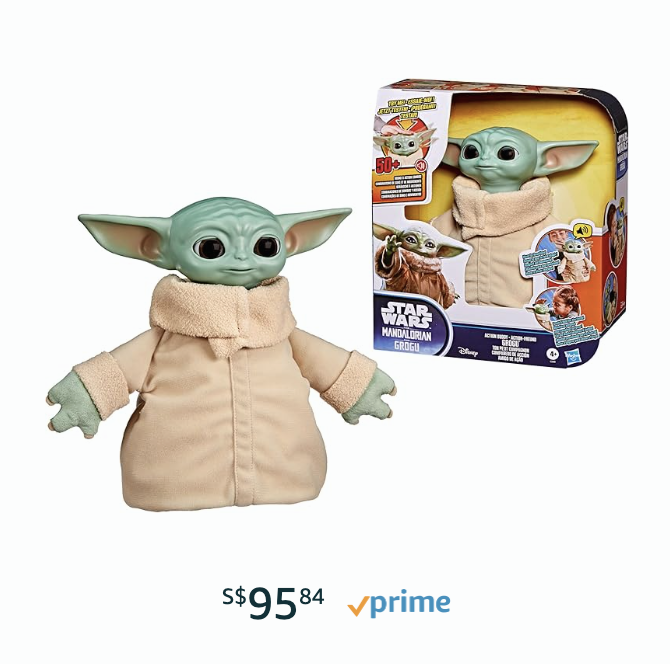
It’s just old guys, collectors, buying the terrible looking $95 Baby Yodas. This is an industry in decline.
The consumer products (CP) segment is basically flat/dying off. The company is almost entirely a segment of the business called Wizards of the Coast (WotC). WotC encompasses the digital side, so a few games with Hasbro’s IP (the massively successful Baldur’s Gate 3 (BG3) for one), Dungeons and Dragons (DnD), the revenue from a game Hasbro licensed out called Monopoly Go! (MG), which is shockingly successful, and critically, WotC includes Magic: The Gathering (MTG).
I’m going to give a bit more background before we delve into my research though. So, HAS has really solid IP. They own Transformers, Peppa Pig, Play-Doh, GI Joe, My Little Pony, Monopoly, Nerf, MTG, DND, PJ Masks, and over 190 various brands in their “vault.” Chris Cocks is their current CEO, former president of WotC. He took over in 2021, in the middle of an activist fight, as Alta Fox was pushing for WotC to be spun-off from HAS, which, frankly, it absolutely should have been, espescially in light of, at the time, recent and terrible acquisitions. Instead, the company held on to WotC, and WotC has just come to dominate HAS. As of the Q2 earnings today, the earnings that broke me in twain, WotC makes up 60% of HAS’s revenue and more than a 100% of its EBIT. It is growing at over 25% y/y. In turn, WotC is almost entirely attributable to MTG, which makes up around 80% of WotC’s total revenue.
So, if you’re doing the math, Magic: The Gathering directly makes up around 37% of HAS’s revenue and probably around 70% of its EBIT. Now, at this point, you’re likely thinking first “Holy shit how is he just getting to this stuff 800 words in,” and then “Also, holy shit this is not a short you dumbass.” I would not be offended if you thought either of those things, don’t worry.
MTG is a classic golden-goose, an excellent, fast-growing franchise, with a fanbase that plays their entire lives, is deeply present in the MTG world (people who spend money on Magic: The Gathering aren’t paying for a ton of dates I’d imagine), and MTG cards even operate as financial assets, like watches or shoes. R/mtgfinance, a Subreddit dedicated to profiting on trading MTG cards has over 170,000 weekly visitors. And as my cruel jibe at them would suggest, these players are huge nerds, which I am allowed to say, as someone who has watched thousands of hours of Star Wars videos on YouTube and has an active D&D campaign. Because the players are huge nerds, they gobble up pop-culture collaborations, or “Universes-Beyond,” as HAS phrases it. The recent Marvel collaboration was panned on the MTG subreddit (700,000+ weekly visitors) for lack of creativity, for being pointless slop with little in-game applicability, and for being symptomatic of greed issues at the company. It set a record for most sales within one-day, within one-month, and was the fastest set to reach $300m, making it the second-largest Universes Beyond (UB) of all-time.
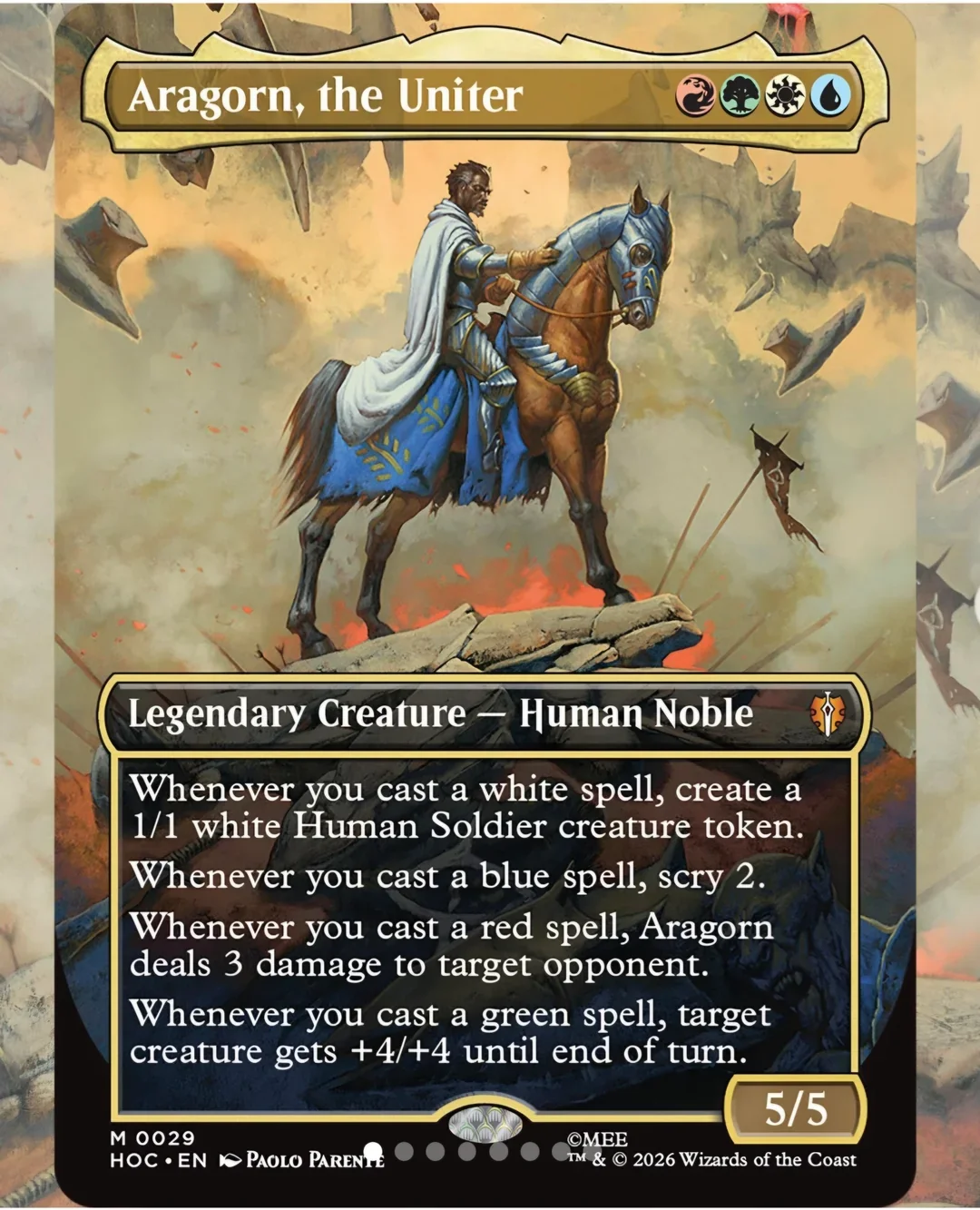
LOTR set was the second-best selling OAT when released in ‘23. Hobbit set being released in Q3.
Universes Beyond, to clarify, basically means something outside of the normal continuity, like outside of the in-game universe. So, you can play your Spider-Man or Aragorn card in-game, but they are not like canonical, as there is a MTG story that the WotC produces cards for (I believe). Usually, HAS likes to release three UB sets and three normal, MTG-originated sets per year. HAS has to pay higher royalty fees, obviously, for these collaborations, but they make ridiculous sums of money, bring in new players, and they are unique.
The takeaway you should have right now is that this is a company with one growth lever that it is pulling vigorously, in MTG. The company cannot double down on toy-manufacturing. That is just a pathway to a death by a thousand cuts, as, again, a physical toy is probably behind 8,000 other things vying for a kid’s attention at any given time, and they are so boring. HAS failed terribly when it tried to go into entertainment, with the disastrous purchase, and then sale at a huge loss two years later, of eOne (where Peppa the Pig came from). To me, this set-up seemed like a pathway to potentially over-indexing on MTG. In the same nerd-vein, I was reminded of the superhero buildout and the ensuing Marvel fatigue as quality lagged and production continued to ramp higher.
However, betting that a highly profitable segment of a company would drop from 32% growth y/y to what, 25%(?), on vague ideas of overproduction, seemed to bear no fruit, and outside of perennially pissed off Reddit users (who seem to both detest WotC and spend hundreds if not thousands of dollars a year on Magic), nobody seemed to care about Magic’s supposed overproduction. I thought maybe there was something in the departure of key personnel, a guy named Ken Troop, a guy very high up in the MTG process who left and effectively started a competitor at Fanatics, but a true competitor is something that takes years if not decades to build-out, and all I had was a few job offerings and a few articles. Maybe there was something the market was missing with Monopoly Go? This was a segment of the business I had experts telling me HAS stumbled into, something that really patched up their operating profit, and I was looking at data telling me players were falling off a cliff. However, due to the contract structure, it is likely that even though player count/retention was falling for MG, HAS’s cut likely would not fall below 80% of peak for a while, ~$40m operating profit a quarter.
Then, I thought, you know, maybe there is something in CP. I started pulling up figures and listening to expert calls in which both were dissecting that segment of the company in an unfavorable light. As we’ve mentioned, HAS is selling fewer toys than before, kids don’t want them, they’re relying on licensing out so many more of their products. And while those were all true, there is nothing new per se, in there or much to work with. With entertainment, there was nothing, and it is a really small part of the company.
So, naturally, I started looking at management. Who are these people, what are their goals? I felt very unsure of the board’s quality, in-part due to the eOne acquisition, and also the general lack of toy-making expertise. In fact, reading more and more about the board, about the company’s internal leadership, I noticed a trend. Out of Hasbro’s six executives, three, the CEO, the President of WotC, and the Chief Marketing Officer all came directly, or spent significant parts of their career in significant roles, within the video-game industry. Out of the twelve members of the board, five were video game transplants. When I was reading through filings, there were certainly a few mentions of the video-game buildout, and out of every SS reports, one or two would mention the video-game segment.
Now, this is not like a string I pulled and the entire Gordian Knot came undone, just sort of accumulated signals that this was a segment of the company that seemed to be broadly undercovered and under-focused by the market, something that would start to be covered by the market much more seriously within the next year due to video-game launches, and something at which I actually had a pretty decent amount of incoming knowledge as a sigh gamer myself.
At this point, I will explain everything as it was in my mind a day before Q2 earnings came out. Booking some slight MTG slowdown would not be unreasonable, but I actually was more optimistic on the segment than consensus because I know the people who play this game, and without being derogatory, this is what they have. They are enveloped in this culture, the conventions, other video-games, their local shops/tournaments, in a way that was being underrated, espescially because management does this super annoying thing where they intentionally massively under-guide for WotC/MTG, like literally projecting MSD/HSD growth for a segment that is nothing but a pure compounder, coming in, no-joke 1,000-1,5000 bps below consensus, which is in-turn 1,000-1,500 perennially below the results. To jump ahead for a second, for this most recent quarter, they were projecting MSD growth y/y, consensus was around 15%, and I was thinking 20% or a bit north, and MTG came in well over 30%. On the call, management proceeded to raise FY26 guidance but not 2H guidance, meaning they were effectively just booking in their full-year guidance the beats that had already occurred and STILL UNDERRATING IT. Management is so scared of overestimating themselves, which is probably scarring from the Alta Fox activist push, but holy shit it is so annoying, obviously because an overly-optimistic management team makes shorting so much easier, but also because it just de-stabilizes numbers and you can’t really trust what they say.
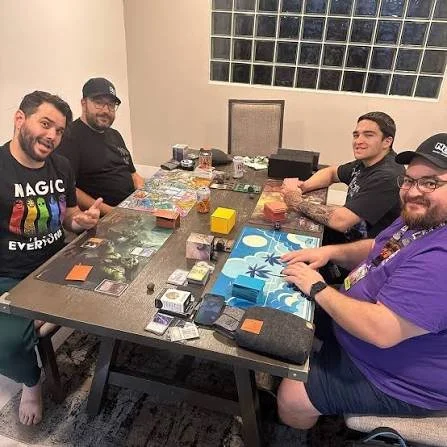
These guys are dropping a band a quarter on MTG, but they seem chill. Guy on left needs to put socks on at least. Dudes who put on all their clothes except for socks/shoes indoors have become way too prevalent. I don’t want to see those bro!!
I digress, that just was very pesky. Anyways, so I am actually booking consistently higher MTG growth than consensus, through the end of Q2/Q3, which is when exit would be most optimal. I am more pessimistic than consensus on CP because, as I’m sure you have been able to pick-up, I have very little respect for this segment of the business, the historical catalysts for growth, these big blockbuster pop-culture movies, are wayyy less popular/culture-defining than they were before, management has shown that they basically couldn’t care less about CP, and the segment literally runs at an operating loss. Net revenue has grown at a dazzling negative 11% CAGR since ‘22 Even though management is very conservative for MTG, they can’t say anything to the effect of, “Yeah, we’re Hasbro, but we think toy-making is a dead business,” so they just keep projecting 2-3% growth across the board and hope MTG grows at a fast enough rate that the market doesn’t notice that, even adjusting for the 1.2 BILLION goodwill writedown they completed last year, that they blamed on “tariffs” (when I read that I rolled my eyes so hard they got stuck looking at my brain), their EBIT shrank by 25%.
I will digress again for a second, but good LORD, why does nobody on any SS team ever ask any tough question. Every single earnings-call, they literally fall over themselves and caveat anything that could remotely present a tough answer, and then just end up asking about MTG anyway. I am probably just noticing it more because this is the most comparative knowledge to the market I feel like I’ve had on a name, but it irked me a bit this time.
So, now that I have established what this company is, why video games are such a big deal for them as the only non-MTG potential growth lever at their disposal, and slightly less relevant, that this management team is playing to the market instead of just working with the qualities/lack thereof of their current situation, I’ll explain specifically why I am so pessimistic about Exodus, and why I believe that it has the potential to do massive damage to this company’s stock.
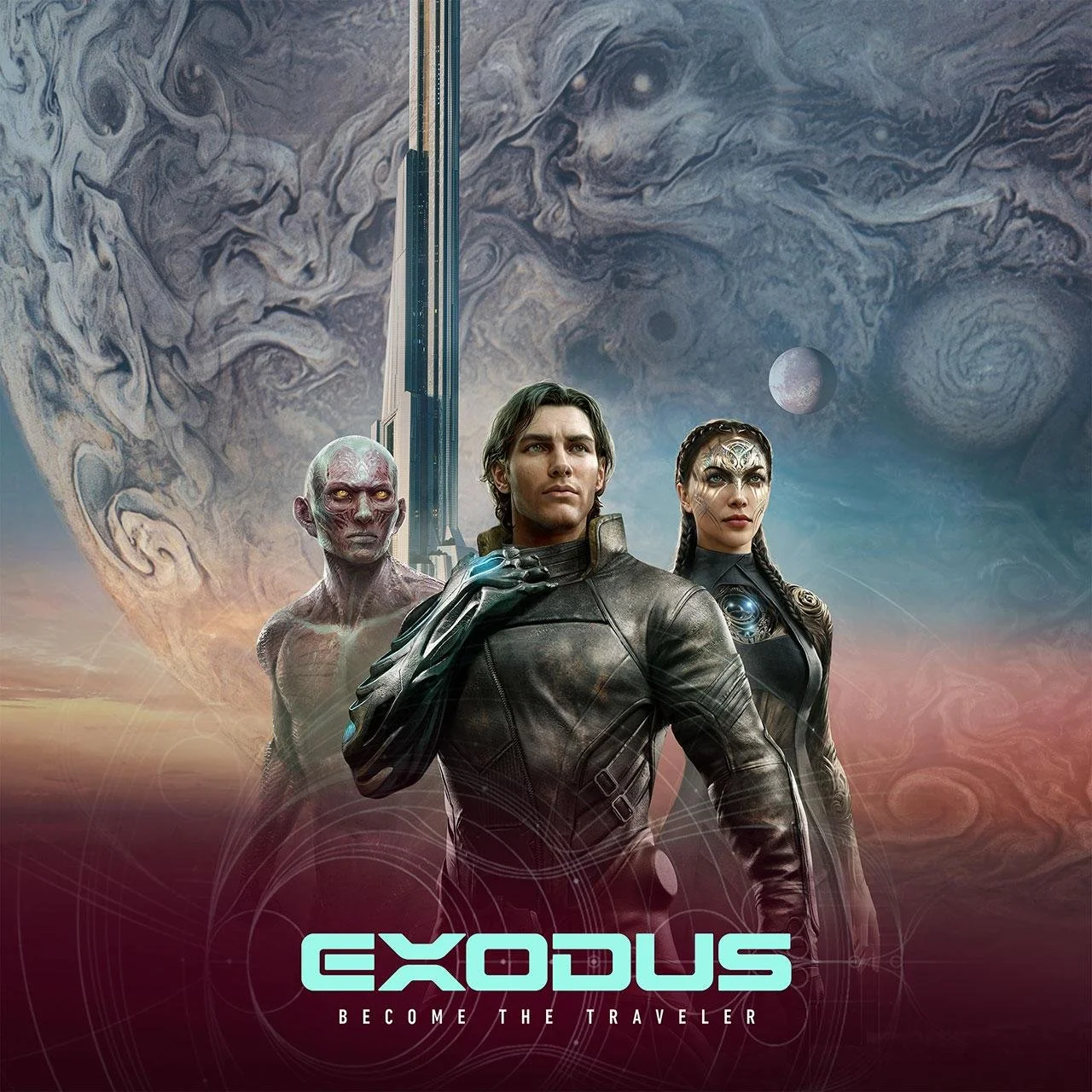
Cool art!
Before Chris Cocks took charge in 2021, a man named Brian Goldner ran everything. Around the 2018-19 area, the the company was in a bit of a rough patch. The company was really dominated by non-gaming (non-MTG, non-DnD, basically just the toys+licensing of IP), which made a bit over 2/3rds of the company. MTG was still strong, but back then, it made in a year (~$500m), what it now makes in a quarter ($545m), and was growing much slower, around the ~14% range. In a move to re-invent itself, a decision was made to invest in video-games very heavily. HAS bought a studio (Invoke Studios), founded Archetype (remember this one) in 2019, founded Atomic Arcade in 2021, and founded Skeleton Key in 2022. These were supposed to be top-tier game studios, focused on making premier, Triple-A content, either creating new IP in the case of Exodus, or taking some of HAS’s deep, current IP and then going and making a game, in the case of Warlock, a DnD game in production by Invoke. Triple-A, by the way, is a vague label attributed to the premier projects, the best of the best, think, like, summer blockbuster, or Marvel movie. These are super-high investment but can easily return hundreds of millions of dollars within a year of launch.
What bolsters the case for this being a good move for HAS is that they had already launched a triple A-game, Baldur’s Gate 3 (BG3), in 2023, and it was one of the most successful Triple-A games of all-time. On a ~$100m development budget, the game made the developers around $450m in revenue in the first year of its launch, bringing HAS around ~$90m, as they had not actually developed and launched the game as their in-house studios would, but instead licensed out the ip to an already established game developer. BG3 is an “RPG” or role-playing game, which means you are in a fictional world as a character, and you make choices that affect the narrative story of the game. Other popular RPGs you may have heard of include Red Dead Redemption 2 (RDR2), World of Warcraft (WoW), Elden Ring, Diablo, Cyberpunk 2077, The Witcher, etc. There are different types of RPGs, WoW is entirely online, for example, RDR2 has an online option, but you almost entirely play as a character within the story.
These are not what are known as “live-service” games, of which the most-famous is Fortnite, where the game is sometimes free, but there is no story with a defined end, but rather continual updates and changes from the developers to keep the game going and the players hooked, whereas in an RPG, once you finish the game, the game is done. You have, although it is far more complicated, beaten the level. The games HAS wanted to focus on were these single-player RPGs with massive, sweeping stories, excellent graphics, and ones that could capture the zeitgeist in the way that recent games like Elden Ring (regarded as maybe the greatest game of all time) or the aforementioned BG3 (regarded as likely the greatest RPG)
My greatest Fortnite skin….The Brat.
Even though HAS had shuttered one of its studios already, Atomic Arcade, they were investing super heavily in the two projects they had announced, Exodus, which was initially supposed to launch November of ‘26 but was pushed to “early 2027” due to GTA VI concerns and Warlock, which will release late 2027. Through piecing together some of HAS’s statements, it seemed as if Exodus would be given a total development budget of $250m, which is…a lot. To put into context how much money that is for a new studio, that is the most money spent on a new franchise (new IP) ever, and almost all of it is just waiting to be amortized, probably $225m+ sitting there. And marketing is not included in this at all. I differed fairly aggressively from consensus on the Exodus budget, even though I thought it was fairly easy to piece together from management’s $350m total provisioning that $250m would be spent on Exodus (was right about this aspect as effectively confirmed by mgmt. in Q2 earnings call, stating “Exodus will be at the top end of the [$250m budget] range,” but I really differed from the market on the marketing costs associated with this game.
Getting a rule-of-thumb for marketing spend on AAA games is tough. Often, game developers are private companies, and when they are massive, public companies (TTWO, EA), they don’t generally break out budgets, but marketing is even tougher. When looking, I was trying to find % of development (dev) budget spent on marketing, meaning that if a developer spends $100m on development of their game, the coding, the story, the game itself, and spends 80% of that budget on marketing, then the total cost of the game is $180m, as they spent $80m on marketing and $100m on the game development itself.
There is a Polish games company that has one of the highest-quality game series of all time, with The Witcher, and they also made the massively successful Cyberpunk 2077 (2020). Adjusting for inflation, this Polish company spent around 82% of their total dev budget on marketing for Cyberpunk 2077 (~$181m) (which was admittedly, a huge, huge marketing push) and 109% of their dev budget on marketing for The Witcher III, or $46m in 2015. Other comparisons I could find (all inflation adjusted)—GTA V spent 93% of their development budget on marketing in 2013, with a $182m spend, Dead Space (great game) spent 100% of their development budget, or $88m on marketing in 2011, and in 2006, Lost Planet spent 100% of their dev budget, $41m, on marketing. On DLCs I could find recently, a Tomb Raider DLC spent ~40% of its dev budget, or $46m on marketing in 2018, and a Cyberpunk DLC spent 35% of its development budget, or $24m on marketing for a 2023 DLC.
These were legitimately the only hard-sourced to widely accepted figures I could find, but the general rule of thumb I found online, in game-developer forums, in a few chats I was able to wrangle with a few industry guys, is that for AAA marketing, you would typically spend 30-50% of your total spend, or 60-100% of your development budget, on marketing. The consensus numbers I was reading were ridiculously underselling the cost of marketing. They were throwing out numbers like $40m total in marketing for Exodus, which just isn’t even in the ballpark of what you would need to spend on brand-spanking new IP for a game of this size.
If the general rule of thumb would be 60-100% of dev cost spent on marketing any old AAA game, then for completely new IP like Exodus, I figured a 75% of dev cost marketing spend would be, if anything, conservative, which is a phrase people throw out in pitches to provide credibility for bullshit, but the numbers I was looking at were telling me that 75% of dev cost being spent on marketing, or around $187m of marketing costs would not be ridiculous, which as I said, is over $140m of incremental costs that the market was not recognizing as being likely due to, I believe(d), inexperience with the video-game industry, a weird, overly-trusting relationship with this management team, and lack of management coverage of their video-game spend (remember, everyone only cares about MTG), meant that everyone was missing the forest for the trees, and these pointless quarterly numbers on, if MTG grew 30% vs 34%, or what new bullshit management was going to concoct to explain why the CP segment was dying a slow but steady death.
So, at this point, I was looking at consensus underrating the raw development budget for this game by around ~$100m in some cases (mid-$100s on Exodus, vs. a game clearly being billed at $250m), marketing spend being around $140m more than consensus (and really, the kicker is that I could only find a few sources who even spent any time building out any sort of Exodus notes), and consensus was missing comparatively small details in the few builds I could find like the 5% cut of units sold by the Unreal engine Exodus runs on or the 30% distribution fee platforms like Xbox, PlayStation, Steam, and Nintendo take.
With all these items, I was able to write-out a break-even point on EPS for Exodus, a units sold the game needed to hit to have a neutral effect on EPS. Management was guiding for a small loss on Exodus, having mentioned it before in calls, so neutrality on EPS would actually be a win.
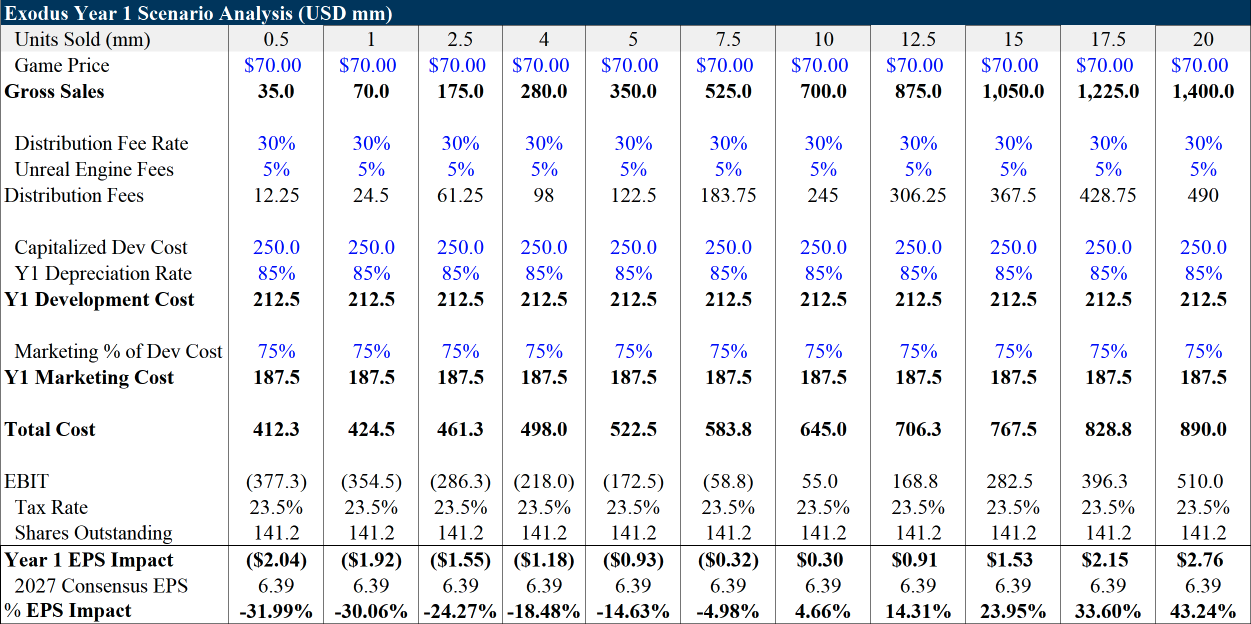
~8.8m units to break-even
I’ll be honest, when I worked this out, I was a bit happy, which was a bad sign, bias had surely crept in, but we’ll sadly discuss further in the post-mortem. For right now, I was feeling good. To reach just a 5% EPS hit, the game would have to sell 7.5 million copies within its first year, a -3% hit would be 8m copies. So, using 8m as a marker, let me walk you through how hard it is to get brand-new IP, non live-service AAA games to that level. There are just two games that have cleared the 8m hurdle in their first year ever. The first is Elden Ring, which, again, is widely regarded as one of the best games of all time, possibly the best, certainly the best of the 2020s. This game came from a man named Hidetaka Miyazaki who is credited with the creation of the Dark Souls trilogy, also regarded as some of the greatest games of all-time. The second was Black Myth: Wukong. We don’t have to spend much time on this. It was a Chinese game the CCP effectively propagandized, and 80% of sales were domestic Chinese. The next closest comp out there is Ghost of Tsushima, a sick-ass samurai game that sold 6.5m copies in its first year, and it was a PlayStation exclusive, meaning for its first year, it was only on one of the four most popular platforms, so it would have almost certainly broken through the 8m ceiling. However, it was released in early July 2020, during the throws of the pandemic, so that augmented sales heavily.
There is one recent example, Clair Obscur: Expedition 33. This was a game with under a budget $10m, independent, launched on Game Pass (will elaborate) that won GOTY+a ton of other awards and like a month ago crossed 8m, right at its anniversary. This game is obviously the exception, espescially because 3m of those copies sold are attributable to winning GOTY and effectively sweeping the other awards (like a movie winning the Oscar for best-picture on the third week of release). This game is not AAA, and while there was outsourcing, it was the studio’s first, and it was new IP. So, it’s definitely possible, to reach units sold around the 8m range, espescially with a super-heavy marketing push, but this is quite literally the only time it ever happened, and it took a historic critical reception to get to that mark. So like, the window exists, but it is so small, and that is just to literally reach neutrality on the game.
There are two recent, non-Clair Obscur examples of AAA, brand-new IP from a brand-new studio that I think are better comps. First, is the game Concord by Firewalk Studios (2024). This was first-time studio, this was their debut game, and (this is heavily rumored, no attributable, grounded sources) it is believed that the budget and marketing costs were each over $200m, and the game, no joke, sold 25,000 copies and the game was shut down within two weeks, and then the studio was shut down as well. A critical caveat is that this was a live-service, it was multiplayer, and it was a different genre to Exodus (will elaborate on Exodus content later), but the implosion is still relevant because this was a new studio entrusted with new IP and given a ton of money by a huge corporation (Sony) explicitly because of the experience the staff had. They were all coming from experienced studios themselves, experienced franchises, which is, coincidentally, the reasoning being used to justify Exodus, that the staff is coming from the blockbuster franchise, Mass-Effect, which Exodus is modeled after.
The other, higher-quality, comp is a game called Immortals of Aveum by Ascendant Studios (2023). This was a brand-new studio with brand-new IP. The total dev budget was a solid AAA number of $95m, the studio was staffed with experienced developers from well-known studios, the game used the same engine as Exodus and was single-player. The game sold a few hundred thousand copies, and an ex-developer said that the game was “massively over scoped for a studio’s debut project,” and that a big-budget, single-player, new-IP game was a “truly awful idea.” Massively over scoped for a studio’s debut project could be Exodus’s tagline, espescially as Exodus will have 2.5x Immortals of Aveum’s budget.
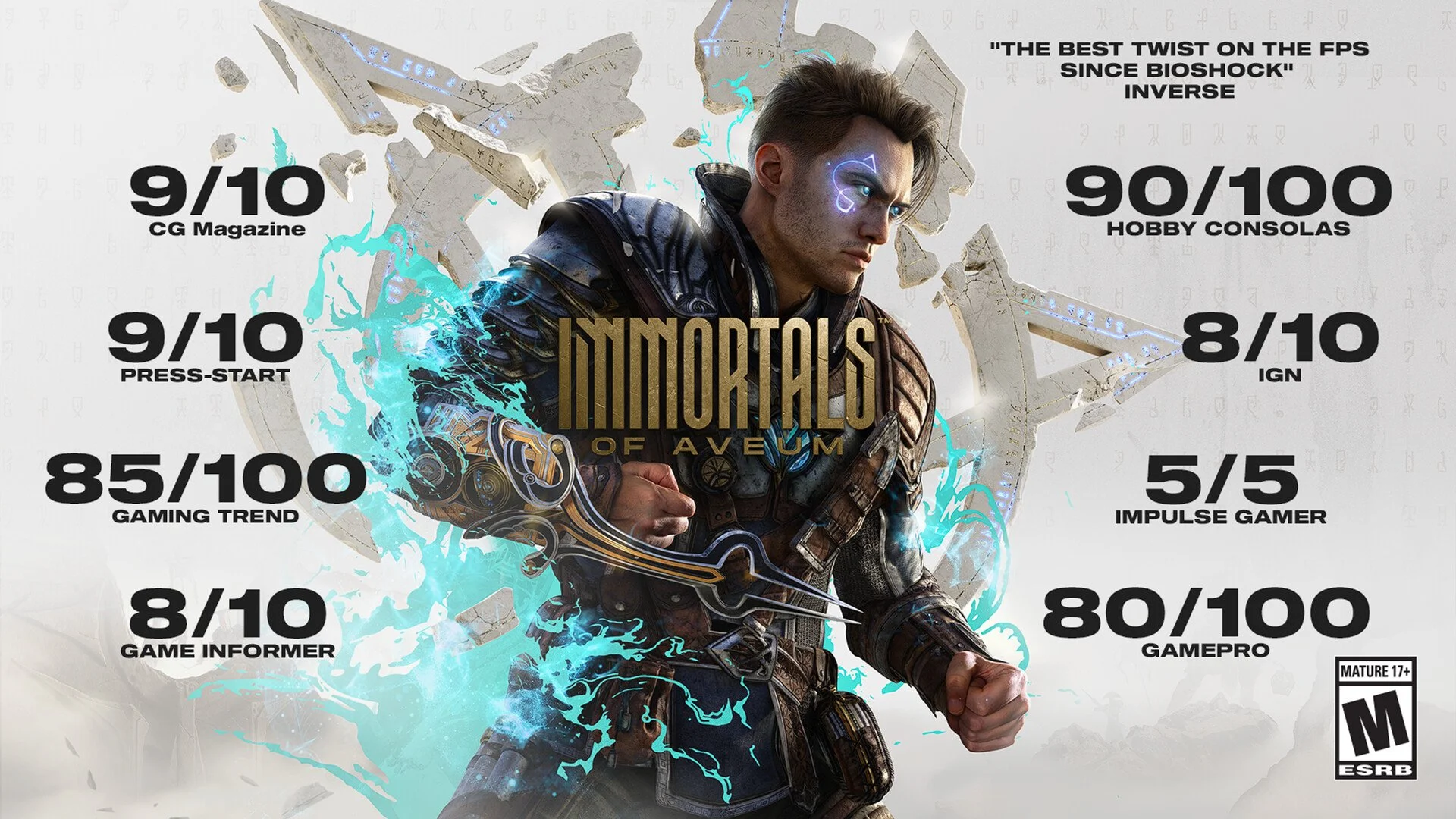
Tbf that is a terrible haircut they gave this guy. It is a FPS, but dayum!
So, what exactly is in this Exodus game if it is being backed with so much money. Does it have the potential to reach these GOTY/generational game levels that new IP seemingly needs to reach to sniff the ~8m tier? Maybe, possibly, but I doubt it. This is very subjective, and I cleary, and unfortunately, have the bias of wanting this game to flop, but as someone who has been pretty dialed into the gaming industry as, sigh, a gamer this game is not giving me great signs so far.
So, Exodus, like its high-budget predecessors has many high-talent employees who worked on extremely popular projects in the past, a lot of which come from the Mass Effect series, a single-player, space-RPG that, as I mentioned, Exodus is explicitly modeled after. Mass Effect’s most popular game, Mass Effect 3, has sold 7m copies lifetime, since it released 14 years ago. Exodus follows a man as he effectively tries to save his world from these alien threats. The game really centers around the idea of time dilation, so basically, when the character leaves to do missions with his side characters, members of your team, you are traveling at/near light-speed, so back home, your world ages years or decades as you work to save it. When home, you operate in a high-depth city, there are animals that speak/understand humans due to evolution, and obviously when you’re out doing missions, there is combat as well, basically looter-shooter. This is a really bold undertaking. It may not sound like much, but the scope of this game is massive, espescially when you factor in the decision-making. The decisions you make have, according to the game devs, huge ramifications throughout the story.
The game is in a space that has fallen out of favor a bit recently (dearth of space-RPGs, fewer Halos), has a great team backing it, Matthew Mcconaughey voices a character, and it has an interesting concept, but the clips I’ve seen look…a bit bland, and scrolling through the Subreddit, I’m not seeing much passion. In fact, people right now are tweaking about the lack of a character creator, which was, to them, a large deal it seems, espescially as game developers had previously explicitly stated that there would be a character creator.
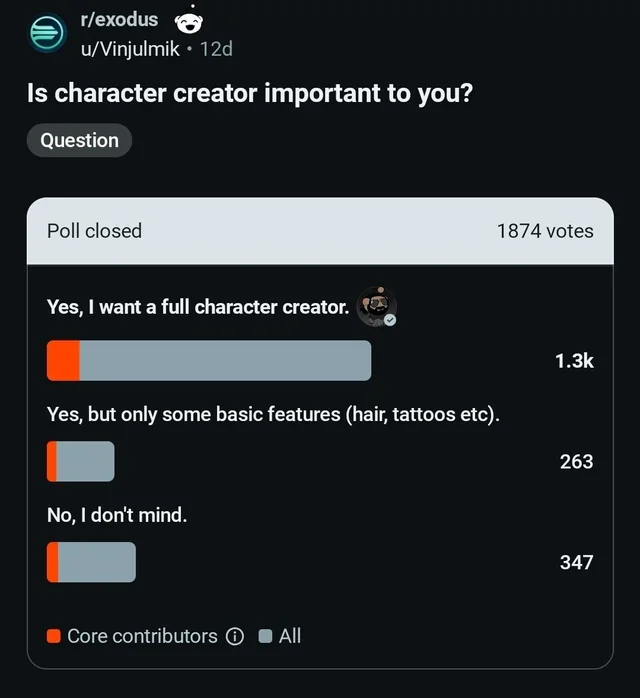
Below is much lower quality, my bad haha
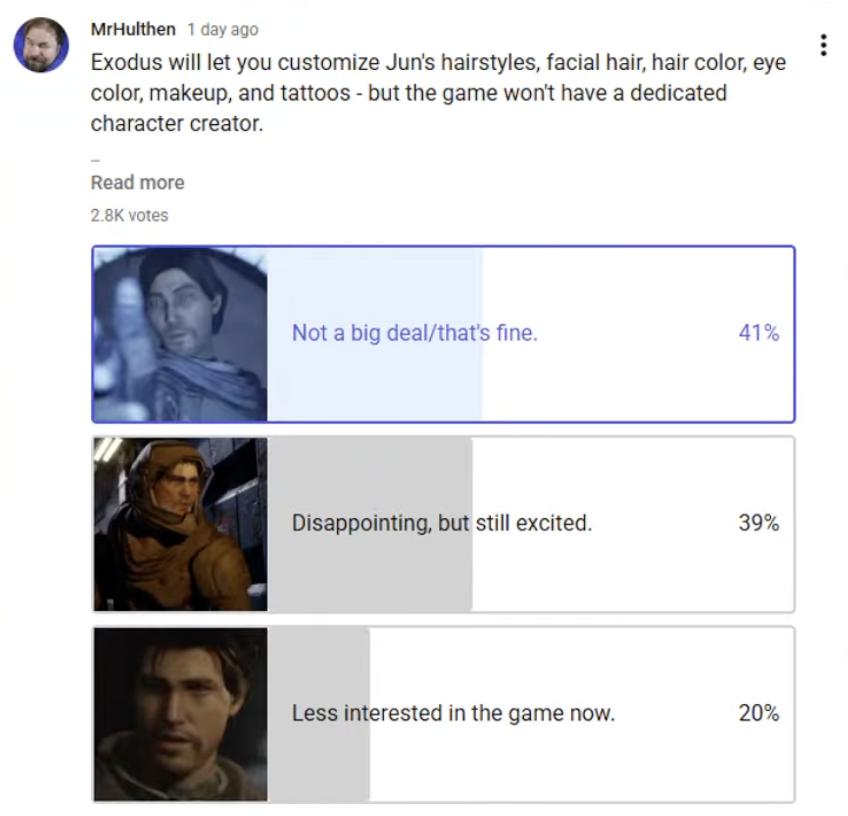
Good YouTuber resource for more information if you want to look more into this game or space
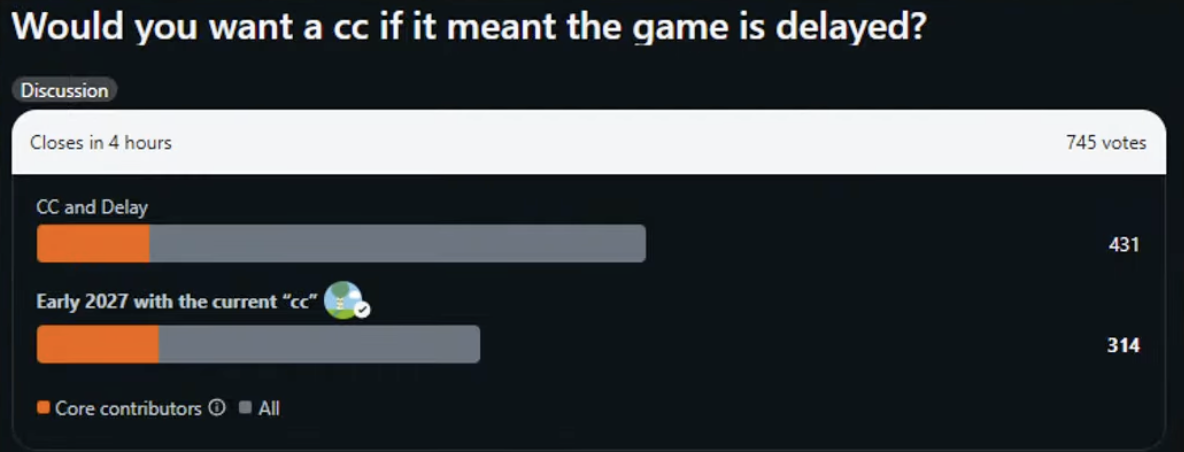
These polls with a dark background came from r/exodus. When they say “current CC” they are describing very minimal like hair design change (maybe) and placing a few tattoos, something along those lines, as opposed to a traditional CC, where you build a character from the ground up.
This is a good video to look at that maybe gives some context. If you look at the comments, and these are the most passionate fans, watching videos about this game 8-10 months from release, seem really passionate about their hate of this move, obviously a small sample size. Here is another YouTube video where this YouTuber explains, in a video with 13k views, that “I can’t express how disappointed I am.” And there are tons of other videos like this, Reddit comments, etc, echoing this sentiment. Now, as MTG proved, geeks who are probably going to buy your product anyway complaining vociferously in their Subreddits or YouTube comment sections, dramatizing their struggles, is likely insignificant.
YouTubers, some of which I attached above, were allowed early access to play the game for a few hours and cited the game as having massive potential but that some of the side-characters were “annoying,” that the city, your home-base felt a bit empty, that the weapons were repetitive, clunkiness with the enemies, and some minor stuff, that can be corrected for sure. If I were a bull, I would want more uniform positivity, but as a bear, my bias would be showing through too much if I ascribed any actual value to these critiques. However, there is an issue that could legitimately be problematic. One of the reasons the character creator histrionics were so aggressive a month ago when news broke was that there is a bit of a visuals problem, that has not improved much throughout repeated gameplay clips, and it was the largest issue cited by the YouTubers who played. Below, I have attached a few images:
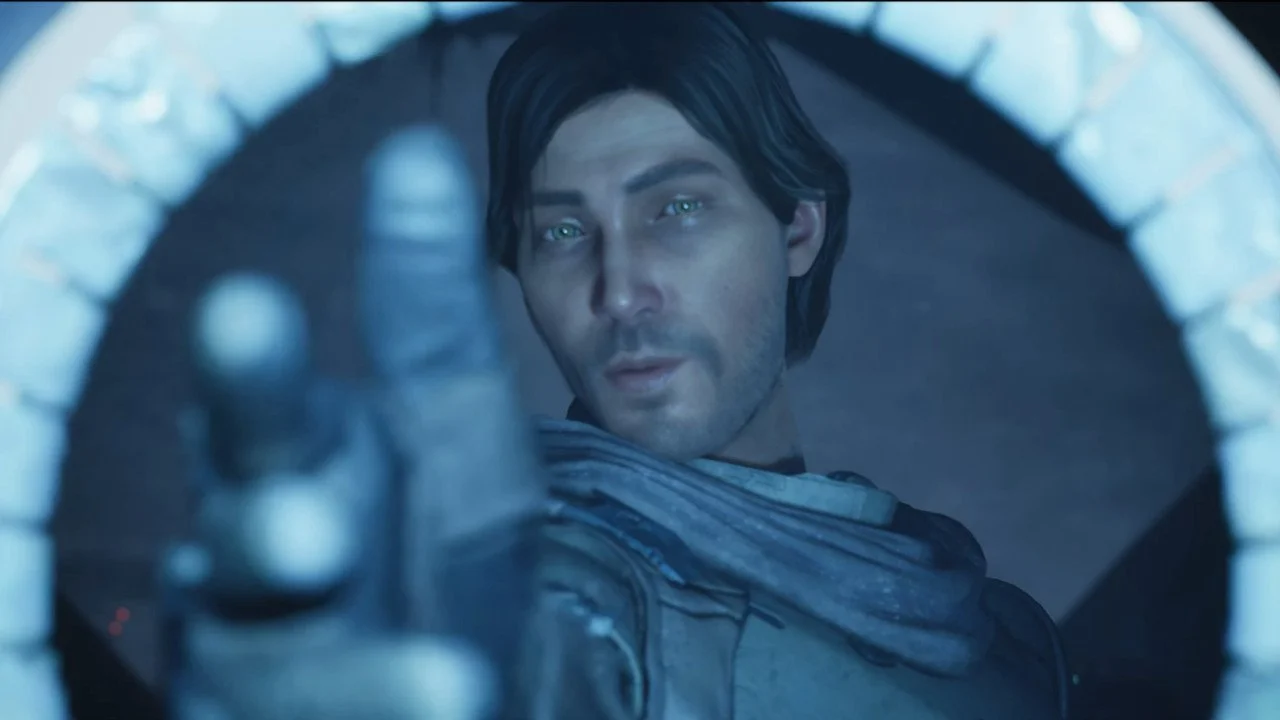
Patrick Bateman voice: Look at that high cheekbone, the tasteful protrusion of it. Oh my God. He even has the wax face.
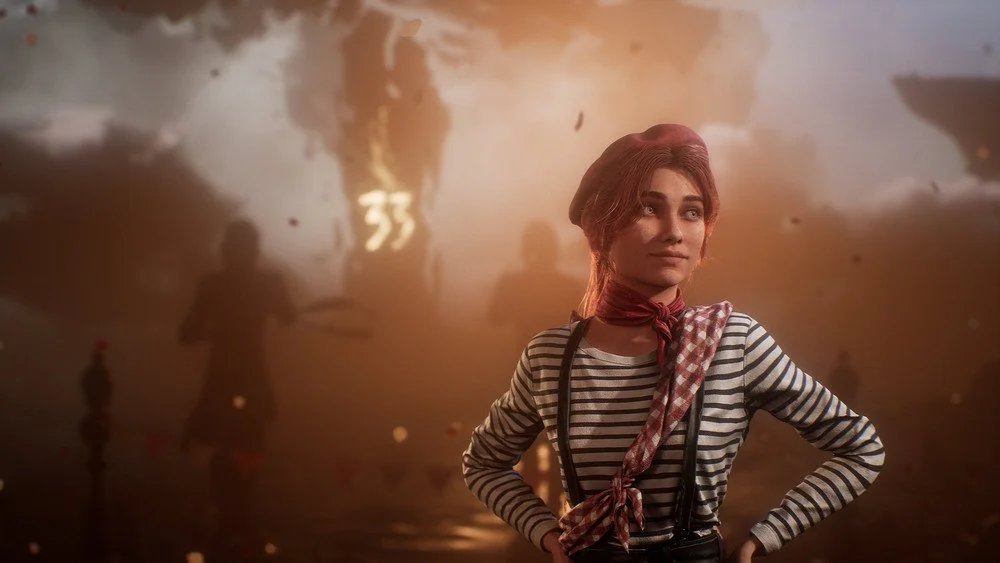
From Clair Obscur for reference of a good-looking character design. The Exodus picture is from a cutscene, so there is no gameplay context excuse. Not sure the context of this Clair Obscur screengrab, but I assume it is a cutscene as well.
If you’re not in this space, maybe you don’t see that this is problematic, but it really is. Especially when coupled with the lack of a character creator, people are displeased online. This other YouTuber with early access said that none of the characters women included, were attractive. I can find you probably 1,000 Reddit threads or YouTube comments or Twitter threads along these lines. I do not think this game is going to flop because of the character faces, or because of the lack of the character creator, or because of minor complaints I’ve heard, or necessarily that this game will flop at all, but there is a very large factor I have yet to mention that will seriously hamper Exodus’s ability to sell, and that is the competition.
The game GTA VI, caused a significant ripple effect by being pushed back to November because nobody wants to release their game around a Grand Theft Auto game, particularly not this one. This is a game that, defining it as “zeitgeist capturing,” would be underselling it. The development budget is well over a billion dollars, it is a sequel to the second-best selling game of all time, and as someone with an embarrassing amount of hours poured into that previous installment, GTA V, I can tell you that, were I not at school, I would play nothing but GTA VI for likely the rest of 2026. Like, the GTA VI Subreddit, and again the game has not come out yet, has 1.5m followers, compared to Exodus’s 11.5k.
It would be incredibly disadvantageous for any studio to release their game around GTA VI, even if they were in totally disparate genres, which is why Exodus, and all the other games releasing around that time have chosen to push their releases back into eary ‘27. This has caused an intense crowding-effect. Here are the AAA games releasing in 1H ‘27 now.
Stranger Than Heaven (Jan. 15): This is what is known as a JRPG, or Japanese RPG, pretty popular, part of the broader “Yakuza” universe, a series of very popular games, probably about 2.5m copies sold. STH is probably a 2 on the crossover/audience cannibalization scale.
Tomb Raider: Legacy of Atlantis (Feb. 12): This is a very popular series that has fallen off a bit, but the last game in the series, Shadow of the Tomb Raider, which released seven years ago, still sold ~4m copies in four months. Amazon is also directly backing this game, so I am expecting a significant marketing push. TR: LoA is closer to a 4 on the cannibalization scale due to potential for oxygen to be taken up, but it is still a different genre, not an RPG, and its modern strength as a franchise is unknown.
Persona 4 Revival (Feb. 18): I would guess ~3m copies sold, in line with others in the series. This is another JRPG, but like STH, it is still AAA and could take oxygen, so 2.
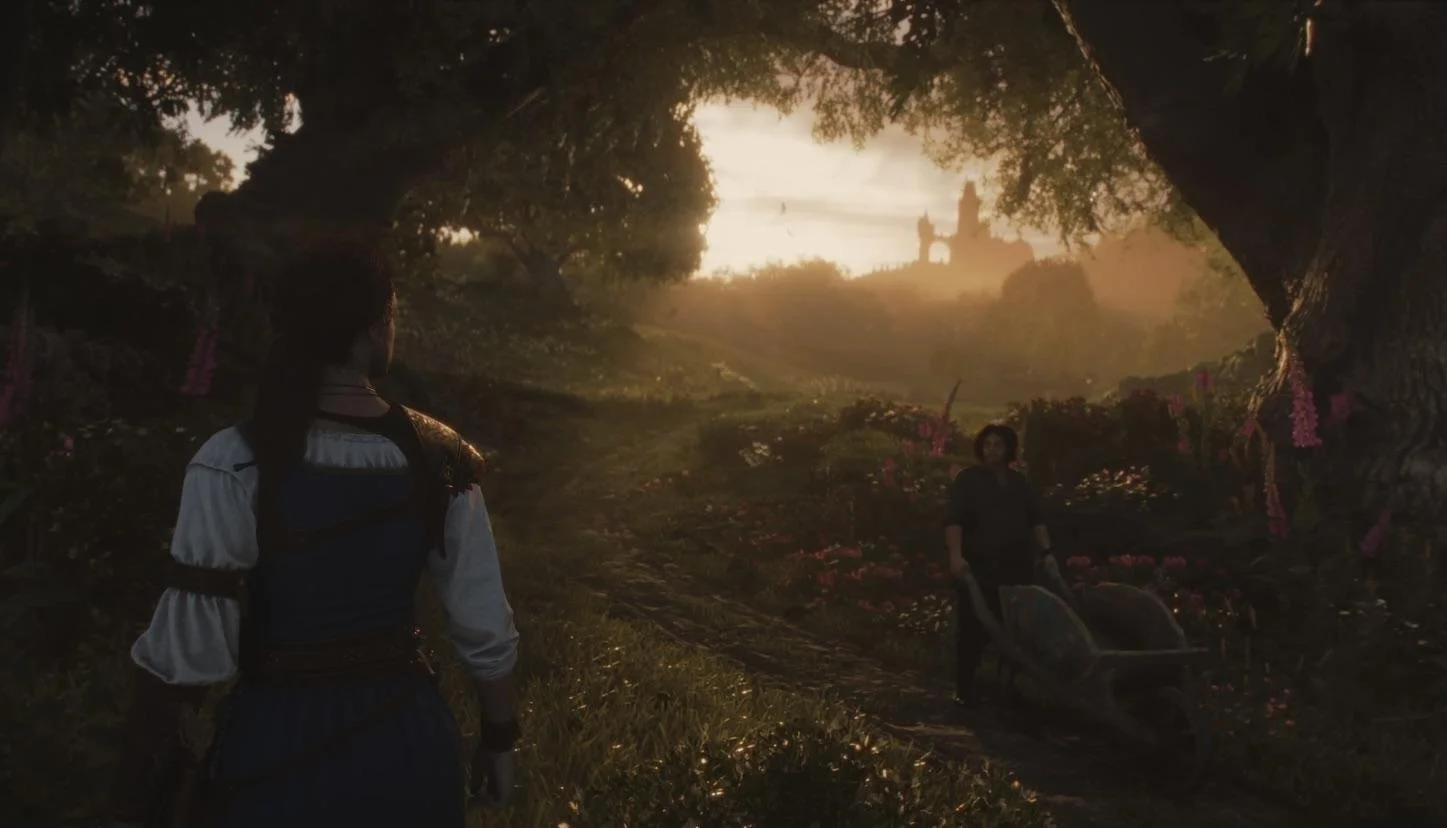
Fable graphics are supposed to excellent
Fable (Feb. 23): Fable is the first entry in this series since Fable III in 2010, and in the 2000s, this series average 3m+ copies sold per title. Fable was never massive, but it was limited by being Xbox-exclusive, which this will not be. This is a fantasy RPG that is directly backed by Xbox Studios, so I would expect a massive advertising campaign, espescially because Microsoft pushed it back into early ‘27 explicitly to give the game a “dedicated moment,” so it seems like they will spend aggressively in a flagship manner. Listed as an early contender for 2027 GOTY, and it will release day one on Xbox Game Pass, which is a benefit I’ll elaborate on later. This, like Exodus, is a single-player, story-driven, choice-and-consequence action-RPG, with an emphasis on companions/romance, reputation systems, and world-building. They are extremely similar in all but genre, so when combined with backing from Xbox, I think Fable provides a substantial threat, and I’d give this an 8.
Metro 2039 (February): This is an post-apocalyptic, FPS shooter, so there’s little genre crossover, and the first three games in the series in the 2010s didn’t crack 2m copies sold, but the most recent title from 2019 broke through and sold over 10m copies. Definitely could be an oxygen-sucker, and the last game’s popularity is threatening, but 2039 is much more horror-oriented, so I think there’s less potential overlap between consumers. I’d give it a 4.
Lords of the Fallen II (Q1): This is an Elden Ring-esque game, and the first game in the series sold ~2.5m copies, but it was marginally profitable, and frankly, not that popular, so I was a little surprised to see it get a sequel. It’s a Western game, but it’s on the smaller side of AAA, so I think it’s more of a 3.
Final Fantasy Seven (Spring): This is an ultra-popular JRPG series, but they sort of churn out a ton of games. If you remember from like 45 mins of reading ago, the most popular Magic: The Gathering set of all-time is the Final Fantasy set, so there is definitely cross-over in the nerd community. FF7 is just a different style than Exodus, so there is some oxygen-capture, but it’s probably a 5.
Wo Long 2: Wings of Ember (Early 2027): This is an action-forward RPG set in China, made by a Japanese studio. The last game, released in 2023, reached 5m total players (not copies sold, but total players), so this is a moderately popular Eastern game, and due to its RPG status, it’s probably a 4, along the Metro line.
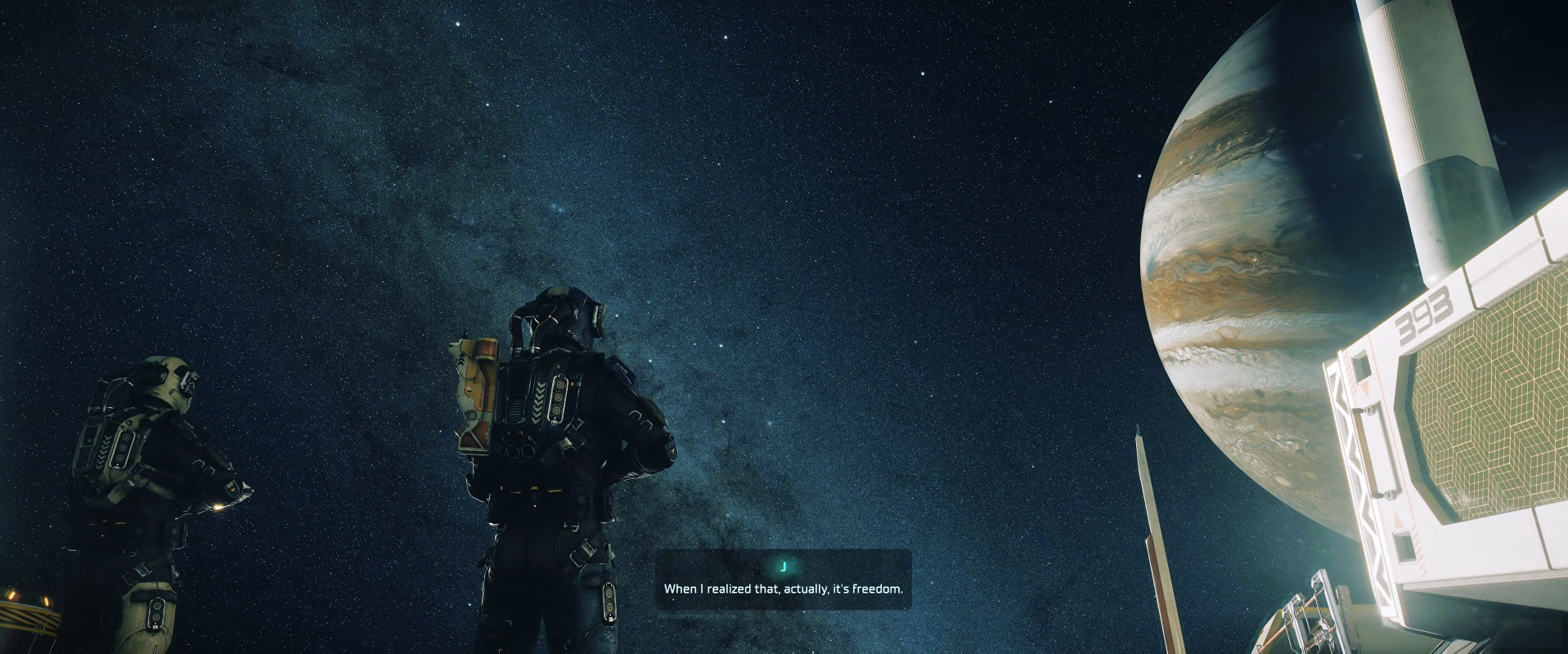
From The Expanse: Osiris Reborn
The Expanse: Osiris Reborn: By far, this game presents the single-largest threat to Exodus. If a 10 on the cannibalization scale is stealing game and releasing it independently, TE:OR is probably a 9.5. Obviously, TE:OR and Exodus are both coming out in “early 2027,” and they’re both AAA games (although Exodus obviously has a much higher budget), but TE:OR is a sci-fi RPG in which you are traveling around the solar system with your crew completing combat missions, romancing/affecting your companions, has a full character creator, and it is also explicitly modeled after the Mass Effect games, with significant staffing coming from those games. These games will directly compete, not only for audience/press oxygen, but for wallets upon launch, awards, and even if Exodus is clearly a better game, unless the difference in quality is so clear that TE:OR horribly flops, TE:OR will cause significant churn.
And the odds of TE:OR flopping are low. The Expanse is IP from a very popular TV show (95% on Rotten Tomatoes). The show was cancelled after S3, and a petition to renew gained 100,000 signatures, it was then picked up by Amazon, and at one point this year, coinciding with a book release by the author in an independent book series, was the third most popular item viewed on PVOD. The Expanse won two Hugo awards, the book-series was a NYT bestseller (yes, yes, who isn’t?), and each book sold averaged a little over a million copies sold. The Subreddit for the TV show has 250,000 followers, and the Subreddit for TE:OR specifically has ~16,000 followers compared to Exodus’s ~11,500 followers.
There is also much more visibility into TE:OR. The developers, who, it is worth admitting, have historically not specialized in these types of games, launched what is known as a closed beta. This is for people who have pre-ordered the game by buying the deluxe version of the game, and its purpose is just general testing of the game, like baking a cake and tasting the batter or something. Reviews were broadly positive. This YouTuber said he was cautiously optimistic. This YouTuber, who also had early access to Exodus, said that TE:OR was direct comparable to Mass Effect 2—“It’s literally Mass Effect on steroids,” and that it “feels more like the spiritual successor to ME2 than anything else.”With Mass Effect being the gold standard both Exodus and TE:OR are attempting to reach, this comparison, made after he had played both games holds significant weight. In the video the YouTuber also said that in TE:OR, the devs “did a really good job making the main character look good,” which, obviously, lies in stark contrast to Exodus.
The only critique I heard mentioned consistently was performance slips (to be expected in a beta) and the voice acting of the male leads. You choose to play as either twin sisters or brothers, so this often-repeated critique could be problematic. This YouTuber, for example, said “everything from writing to gameplay I am really impressed with and have very little to critique…outside of a little bit of the male voice.” CatOwl, the developers of TE:OR, released a statement after the closed launch stating that they were in the process of replacing the lines for the male character, which sucks for the VAs haha, to get dunked on and then fired like that, but tightness around the edges like this will improve sales for TE:OR, I’m sure.
Since I’ve been very qualitative up this point, what are the actual TE:OR’s numbers? As of a little over a month ago, TE:OR had, as disclosed by the game developers, over 1 million wishlist tags on Steam. For context, if a game reaches around 95% positive reviews, it can generally be expected to convert half of its wishlist to sales within the first month. One million wishlists for a game is extremely healthy, espescially as we are still ~9 months from release, so a final count of 1.5-3m would be expected. Wishlist.gg is a site that tracks how many of its members (7m visits a month) are placing games on their wishlist through the site. Right now, Exodus ranks 89th (6k), while TE:OR ranks 12th (16k), and while this really is quite weak since the sample size is so small and the users are the most hardcore PC-specific gamers, it is worth remembering that, to not be a complete disaster, Exodus needs to sell better for what it is than every game like it in history except for, effectively, two games, Clair Obscur and Elden Ring, so the fact that, by all accounts, TE:OR has more momentum right now, Exodus could be in real trouble.
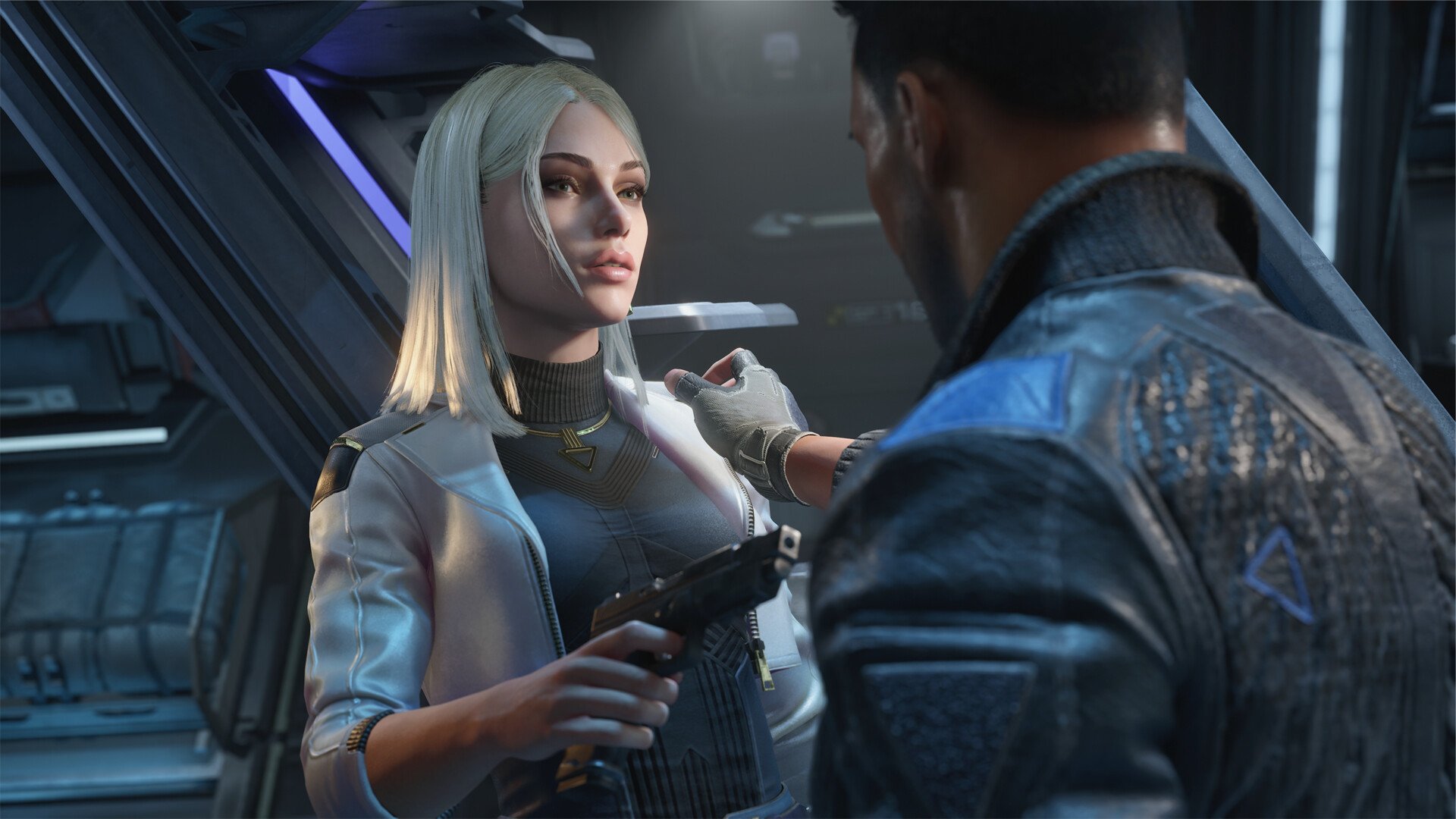
Companion from TE:OR

Companion from Exodus
“I prefer not to speak. If I speak, I am in big trouble. In big trouble. And I don't want to be in big trouble.”
Out of the nine AAA releases in January-May of ‘27, five, will be directly listed on Game Pass, including The Expanse: Osiris Reborn, as well as Stranger than Heaven, Persona 4, Fable, and Wo Long 2: Wings of Ember. Exodus will not be. Game Pass is an Xbox/non-Steam PC program through which subscribers (30m) gain access to games without paying directly for them. If you have a Game Pass subscription, you just open the game. Game Pass players count as total players but do not count for copies sold, and Game Pass absolutely does cannabalize, so for games that feel confident they can sell on their own, it doesn’t make much sense to be a day-one Game Pass game. It’s sort of like signing for a record-label. You need to the promotion if you’re smaller, but if you can create your own noise, it’s not necessary to give up economic leverage. Game Pass absolutely serve to increase noise and player count, so TE:OR being on Game Pass and Exodus not, is yet another worrying sign.
In 1H ‘26, when Clair Obscur launched, there was one RPG, Clair Obscur, but in 1H ‘27 there will be six packed in in. In 1H ‘26 there were five AAA games, and in ‘27 there will be nine. The Expanse: Osiris Reborn is a brutal comp for Exodus to be facing. The Expanse is a defined franchise with a remarkably similar narrative setting, overwhelmingly positive reviews in the beta, excellent visuals, one addressable problem that is actively being addressed, a sizable budget, and a fan-base that is seemingly all-in on the game. Exodus by comparison, is a vastly over-scoped, over-funded game that is seemingly bound to under-deliver on its promises, and optimistically, drown underneath a superior game with better fundamentals but still reach what would be considered a nominal “hit” due to the sheer weight of the money behind the game. As discussed earlier, however, even reaching this nominal hit status of ~4m copies is not nearly enough to prevent the ship from going down.
According to my model, baking in compression from the current 13.5x 2027 multiple to 10.5x based on a loss of confidence with mgmt. and reduced growth prospects from the video-game segment, combined with the direct EPS hit due to Exodus (comparatively) imploding, due to the aforementioned reasons surrounding quality, massive overspend, management oversight, lack of insight from the market, and stifling competition, a PT of $57.28, or a -34.4% loss is, I believe, a fair assessment of the stock’s value. I believe an exit at the beginning of Q3/end of Q2 would be wisest, so as a full quarter of bad Exodus results can work through, espescially as the release date is still unspecified, so a substantial amount of costs can amortize, and so the market can process the negative results before Warlock, which I am much more bullish on, releases in early Q4, late Q3.
In my base case, sans Exodus, I am more than 350 bps more optimistic for HAS’s EBIT numbers than consensus. My short math works out, such that consensus EPS for ‘27 is $6.39, mine is $6.62 (before Exodus), so multiple compression makes up 63% of the downside, 46% comes from a direct Exodus hit, and then 8% comes back up from my optimism sans-Exodus.
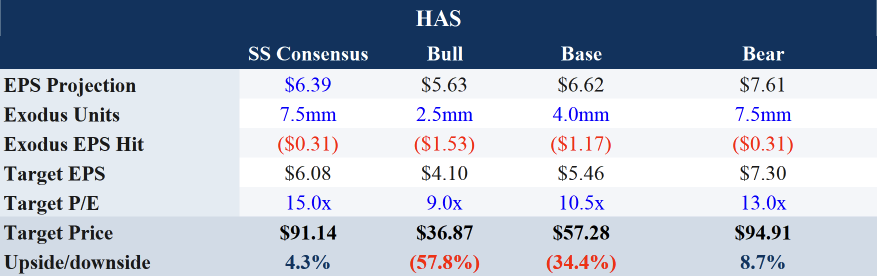
I can make it prettier I swear!
It all breaks—
Or at least that is what I thought. If you somehow made it to the end, I am really impressed! So yeah, this blew up on me, which maybe you’ve caught, as I’m sure I wrote some of my opinions in the past-tense by accident. I was basically waiting for Q2, the Q2 results to come out, which they did a few weeks ago. I was reading reports a day beforehand, and SS was focusing a bit more on video-games, not as much as I thought, in the moment, they should have, but still, a bit more. I was expecting, and looking for, obviously any updates to EPS guidance from Q2, any mention of tough MTG comps in Q4, any more write-downs in CP, the performance of the MTG Marvel set, any numbers on the video-games, or any optimism from management. What I got was a bit disastrous for the short.
The good news, CP did come in less than I was modeling even for Q2. Some interesting partnerships were fleshed out but otherwise nothing. MTG was really strong, over 30% growth from the entire segment, bizarrely licensed gaming was up 16% y/y, which I still need to look into. The Marvel Super Heroes UB set those records I mentioned, and everything is good up to this point. I wanted, at this point, management to say some useless BS that SS would lap up about MTG strength, and then dance around video-games cost, if they said anything I could read into that would be great.
And then they said that they had canceled “several games scheduled for release in ‘28 and beyond” and wrote down the branch by $56m. They had cancelled and shut down one of the four game studios about a year ago, shuttering the GI Joe game they were working on, and then proceeded to bury all of it, so while this was way more pessimistic than usual, I thought maybe it was just re-shuffling. Then, Chris Cocks went on to say that they were going to reduce their digital spend by 25% annually over the next several years, leaning more into “co-development and co-publishing with partners,” as they bring “operating discipline and cost advantages.” And then, the killing blow, Gina, the CFO, stated that they were going to be “booking $20 million of marketing spend associated with video game launches in 2H.” Then, the double-killing blow, the Mortal Kombat finisher, back-breaker explosion, ripping spine out of back, “So the entirety of Wizards next year, there’s anywhere from, call it, $50 million to $75 million of incremental marketing expenses that we’re going to put into this segment to support all of the growth levers.”
Broooooooooooooooooo. I was so, so pissed when I read that. Because, to translate, they are giving up on video-games, and I realized I fucked up so much of this research process, completely guided by my greed for a short, which I will elaborate on in a second. So when they say that they are basically cancelling all their games for ‘28 and beyond, and that they will be leaning into co-development, they basically mean that they are giving up on video-games because MTG is so strong, we don’t need to take this risk. As a company, they don’t need to swing for the home-run, they can just license out their IP and hit singles and doubles. That’s why they are cutting their costs, that’s why they shut down one of their four studios already and while it’s not been reported yet, I’m sure they’re going to shut down at least two, if not three, of their four. I mean, spending less $75m on marketing for both Warlock and Exodus is like comically cheap. They are bracing for a failure, 100%.
And finally, someone asked a good question. This dude from Citigroup, James Hardiman.
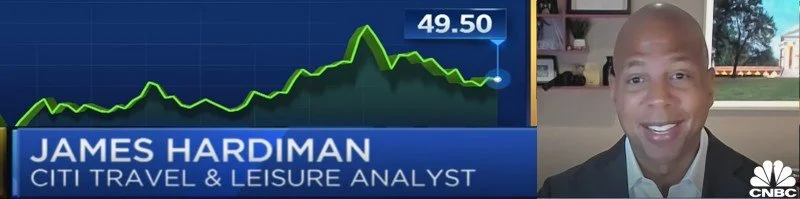
James Hardiman, friend of the show
Jimmy asked why HAS was guiding for high-30s, low-40s margins for WotC for FY27. Great question! And one I would ask as well. Yes, Gina, why is this segment that increased from an EBIT margin of 43% in FY24 to 46% in FY25, and is averaging a 46% margin for Q1 and Q2 2026, why are you guiding for a possible margin in the high-30s? Blah blah blah bullshit about staying safe and being conservative. Translation: Our video-game is going to cause a significant EBIT loss, and when it does we’ll say that we’re staying conservative with Warlock and that we are already transitioning to an operationally lighter model that won’t be as risky in the future—then, some BS about mitigating circumstances. Like, it’s so obvious, and as you can tell, I am still really quite displeased at how this has worked out. Unfortunately, I really have nobody to blame but myself.
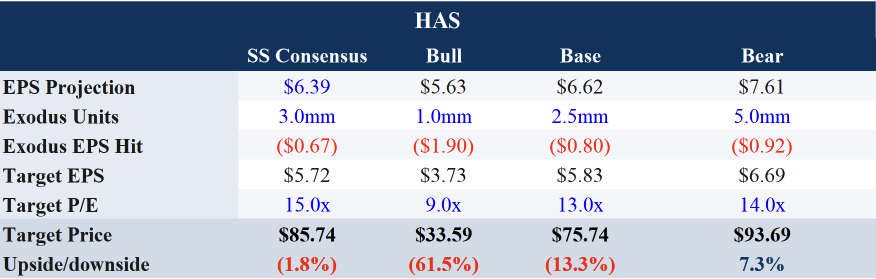
Multiple compression is much less aggressive, even down to 13x is probably a bit much. The math just doesn’t work.
I’ll probably come back to HAS in a few months, keep an eye on it, but as of right now, it just doesn’t make sense to short a business I don’t fundamentally disagree with, so I can wait for a moderate, and now much less expensive, flop that management already knows is going to flop. The way I thought this was going to workout was that the market would, over the next few months, into the beginning of FY27, slowly start to build pressure. There would be more Exodus questions, more pressing on the CFO just randomly dropping on a call that the company dropped $250m on a video-game, that the company would try to out-spend this pressure, and then, due to the myriad of reasons mentioned before, the game would undoubtedly fail to meet these expectations, etc, etc.
But now it is so much easier to see that, while there are truths I do believe in—I believe Exodus will be a comparative flop, I do believe HAS has fucked their approach many times over now, and I believe after Exodus the market will not want to see HAS anywhere near video-games—I was far too cavalier and trusting of these events to play out in a precise order leading up to this big event I actually do have belief in. Like, I can’t just count on these innumerable little details to play out how I want them to, and I espescially cannot let my biases creep in to the point at which I believe it is an inevitability that they will. This has been an excellent learning experience though, and even though I was piissssed a few days ago, I think what I have gained from this is very valuable. Next time, I need to be faster, more careful, and build out my ideas numerically quicker, such that I can augment with signaling the more I research.
Thank you :).